Up to €30,000 for European Micro, Small and Medium Enterprises
The second SECURE Open Call co-finances projects that bring European mSMEs closer to Cyber Resilience Act compliance, with a call budget of at least €11,500,000 and grants of up to €30,000 per company.
About SECURE
SECURE (Strengthening EU SMEs Cyber Resilience) is a Digital Europe Programme project whose mission is to strengthen the cyber resilience of European micro, small and medium-sized enterprises (mSMEs) and help them prepare for the EU Cyber Resilience Act (CRA).
SECURE builds a public Central Repository of CRA resources (guidelines, self-assessment tools, training materials, free and open-source code), runs trainings and workshops, organises events and good-practice exchanges, and brings mSME needs into European standardisation work.
About the SECURE 2nd Open Call
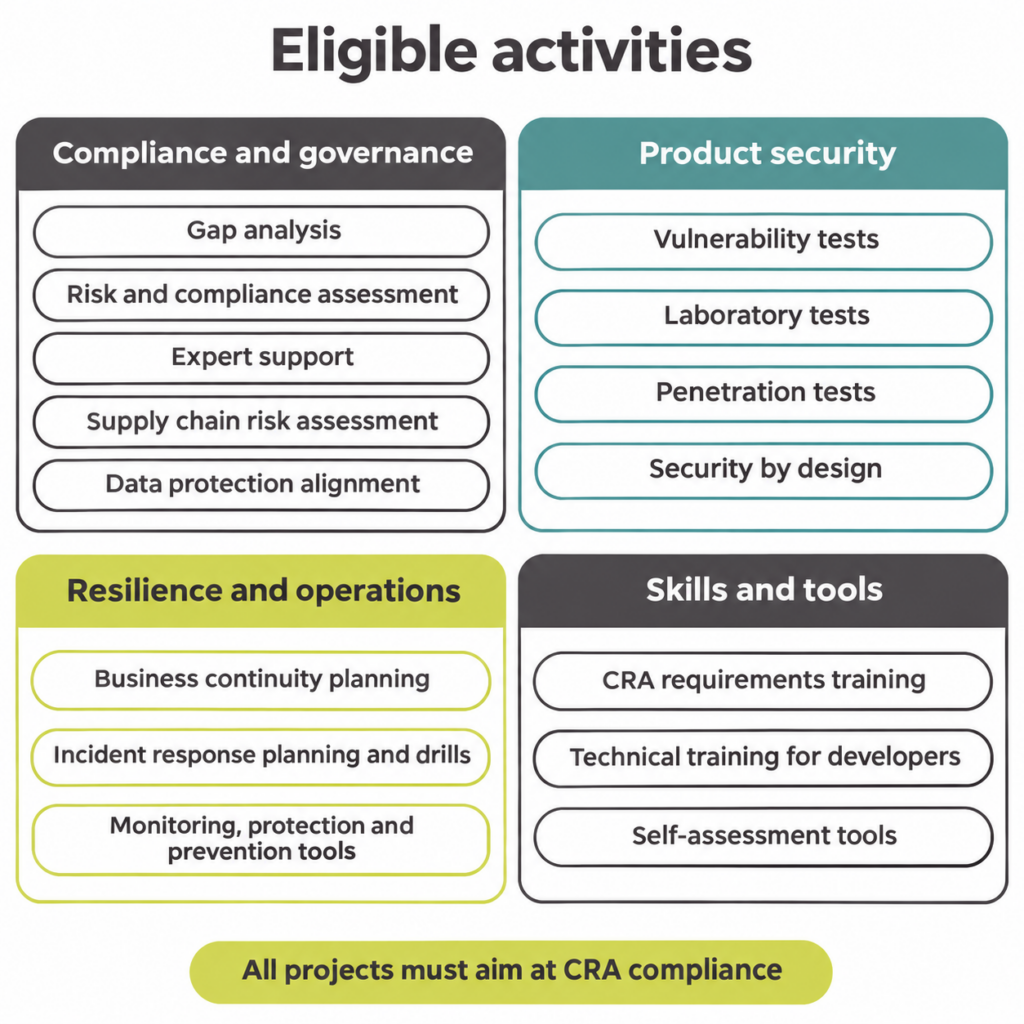
The SECURE 2nd Open Call funds projects that improve the cyber resilience of an applicant’s processes, products, technologies, infrastructure or services, with CRA compliance as the end goal. Eligible activities to be funded by this call fall into 4 groups:
- Compliance and governance: gap analysis, risk and compliance assessment with a remediation plan, expert support, supply chain risk assessments and data protection alignment where it links directly to CRA obligations.
- Product security: vulnerability tests (static and dynamic analysis, dependency checks), laboratory tests, penetration tests and security-by-design practices such as threat modelling, secure coding and SBOM management.
- Resilience and operations: business continuity, incident response planning and drills, and monitoring, protection and prevention tools (intrusion detection, malware scanning, logging, access control, encryption).
- Skills and tools: CRA requirements training, developer-focused technical training and self-assessment tools.
Why apply to the SECURE 2nd Open Call
The call offers a minimum of €11,500,000 in total, and the budget may grow if funds from the first call go unspent. Each company can receive up to €30,000 at a 50% funding rate (lump-sum grant), and this cap applies even when total eligible costs exceed €60,000.
There’s the possibility to request 40% pre-financing at submission, paid at or shortly after the Sub-Grant Agreement is countersigned. The balance follows approval of the final Technical Report. Beyond the money, funded companies get access to SECURE’s repository, tools, trainings and community.
Who can apply?
The call is open to a single mSME acting on its own, that is a private legal entity from an EU Member State o EEA country and qualifies as a micro, small or medium enterprise under Recommendation 2003/361/EC. Self-employed persons whose business has no separate legal personality can also apply, and associations can apply as sole beneficiaries.
How to apply to the SECURE 2nd Open Call
Applications are submitted through the SECURE online platform in two phases. All documents must be in English, except official documents issued by national authorities.
Phase 1 – Registration and eligibility documents:
- Create an account and complete the eligibility checklist.
- Upload the auto-generated Applicant Declaration, signed with a qualified electronic signature (PAdES).
- Upload a valid registration report with a good-standing statement, proof of indirect owners and an ownership chart.
- Upload the signed Ownership Control Declaration (Annex 3) and the latest financial statement.
- Upload any extra documents the NCC requests.
Phase 2 – Proposal and budget:
- Complete the Proposal Template (Annex 1.1) and the Excel Budget Template (Annex 1.3), following the Budget Guidelines (Annex 1.2).
- Link every budget item to a task and deliverable.
- Request pre-financing if needed, then confirm final submission.
Important dates
- 1 October 2026: call opens, with platform registration and submission available from launch day.
- 29 January 2027: call deadline.
- About 3 months after closing: evaluation results.
Proposal requirements
A strong proposal links a concrete CRA gap to a clear plan: objectives, methodology, resources, measurable KPIs and deliverables, with costs tied to each task. Projects run for a maximum of 180 calendar days from Sub-Grant Agreement signature, and costs incurred before signature are not eligible.
Funded companies must complete a mandatory Initial CRA Maturity Assessment early in implementation. Without it the Technical Report cannot be uploaded, and the project counts as not implemented and ineligible for funding. At the end, a Technical Report (Annex 6) with KPI evidence and proof of deliverables (source code, vulnerability assessment results, network mappings or multimedia) is submitted.
Payment depends on delivery. A full achievement releases the full balance, a partial one reduces it by the justified completion percentage (a €10,000 request judged 60% complete would receive €6,000), and a project not achieved receives no balance and may have to repay pre-financing.
Evaluation and selection process
Proposals pass through three stages:
- Formal evaluation by Cyber 4.0, checking CRA relevance, fundable activities, budget eligibility and obvious clerical errors.
- Technical evaluation by the Evaluation Committee, with three evaluators per proposal and clarification requests by email only.
- Company eligibility check by the relevant NCC, which can approve, request more documents or reject.
Each evaluator scores each criterion from 0 to 5 (0 not addressed, 5 excellent), so each criterion has a maximum of 15 points across three evaluators:
- Excellence and relevance (weight 1.5): CRA relevance, compliance gap, objectives, methodology and resources.
- Impact and clarity (weight 1.5): benefits for the mSME, clarity and measurable KPIs.
- Implementation (weight 1): work plan, deliverables, cost consistency, and direct use of tools, outputs or standards from other Digital Europe Programme CRA projects, which is rewarded under this criterion.
The overall score is the weighted average, with a maximum of 15. A proposal is excluded if it scores below 10 in two or more criteria or below 10 overall. If evaluators differ by 5 points or more on two or more criteria, a fourth evaluator is added. Ties are broken in favour of earlier submission.
Additional support beyond funding
SECURE’s Central Repository offers guidelines, self-assessment tools, training materials and open-source code that can support your project. The project also runs trainings, workshops and events, and has a community forum. Funded companies complete an initial and a final CRA Maturity Assessment, and after finishing the final assessment and SECURE surveys they can download a Formal Attestation of Project Completion.
Final thoughts on the SECURE 2nd Open Call
This call suits companies that make or will soon make products with digital elements and want co-funding to prepare for the CRA before its main obligations apply in December 2027. It fits micro and small hardware, software and IoT manufacturers best, particularly those planning vulnerability testing, penetration testing, secure development practices or incident response. The 180-day timeline and payment tied to delivered results reward applicants with a defined, evidence-backed project.
More information
Don’t miss the opportunity that could be the turning point of your success

Follow us on social media so you won’t miss any upcoming Info Days or Cascade Funding Opportunities

Sploro Cascade Funding Webinars – Session #36 Photonics & Energy Innovation