
Up to €50,000 for SMEs, Start-ups and Small Mid-Caps Building Open-Source Agri Apps
NOSTRADAMUS Open Call #1 has a total budget of €250,000 to fund 5 open-source digital applications for data-driven farm decisions across five cereal-focused topics, with up to €50,000 per project in lump-sum funding, a 12-month support programme and access to real demonstration sites.
About NOSTRADAMUS
NOSTRADAMUS is an EU-funded project aligned with the Farm to Fork strategy, the Common Agricultural Policy and the European strategy for data. Its mission is to build a scalable, real-time one-stop-shop that automates the collection, processing and analysis of agricultural data, combining satellite and IoT streams so that farmers get actionable intelligence on yields, resource use and environmental impact.
The platform rests on five Data Cubes, an IoT Observatory and a low-code Application Generation Engine. It also includes four core modules covering drought monitoring, crop suitability and yield estimation, soil fertility and nutrition, and pest management. Five demonstration sites in Cyprus, Germany, Serbia, Slovenia and Switzerland act as pilots, and each is linked to a regional Multi-Actor Platform of local stakeholders.
Part of the budget goes to third parties through two open calls: this one for farm decision-making apps, and a second for policy-shaping applications, planned for 2027.
About NOSTRADAMUS Open Call #1
The call will fund 5 open-source applications that help farmers, cooperatives, advisors and agri-industrial actors make better decisions on water, fertiliser and pesticide use, with a focus on cereal-based systems and food security. Applications must build on the NOSTRADAMUS data infrastructure and combine Earth Observation, IoT and edge/cloud computing.
Applicants choose exactly one of five topics. Topics 1 to 4 are each tied to a core module that the application must build on:
- T1 – Sustainable crop production in cereal systems under changing climate and soil conditions (Crop Suitability module).
- T2 – Nutrient and soil health management, including soil fertility indicators and precision fertilisation (Soil and Nutrition module).
- T3 – Water efficiency and drought resilience, using early warning outputs and IoT soil moisture monitoring (Drought Monitoring module).
- T4 – Smart, predictive pest and disease management to cut pesticide dependency (Pest Management module).
- T5 – Open topic: integrated decision-support apps combining at least two of the modules behind T1–T4.
Why apply to NOSTRADAMUS Open Call #1
The call has a total budget of €250,000, and each of the 5 selected projects can receive up to €50,000, covering 100% of project costs, indirect costs included. Funding comes as lump sums released after each of four programme sprints:
- Sprint 1 – Training (months 1–2) [10%]: mandatory onboarding with at least 10 hours of guided learning, covering data governance and co-creation, the NOSTRADAMUS ecosystem, data usage and application development tools.
- Sprint 2 – Design (months 3–4) [25%]: co-creation with stakeholders from the Multi-Actor Platforms and a validated technical design.
- Sprint 3 – Development and Validation (months 5–10) [40%]: building and integrating the prototype and collecting validation evidence.
- Sprint 4 – Demonstration and Assessment (months 11–12) [25%]: on-site demonstration, end-user training, impact assessment and the exploitation plan.
The call guarantees at least one funded project per topic, provided the proposal clears the minimum scores, so you compete mainly against applicants in your own topic.
Who can apply?
Applications come from a single legal entity or a consortium of maximum two entities, established in an EU Member State or a Horizon Europe associated country.
- Single applicant: must be an SME or start-up (under 250 employees, turnover up to €50 million or balance sheet up to €43 million) or a small mid-cap (under 499 employees, turnover up to €100 million or balance sheet up to €86 million).
- Consortium: the lead must be one of these business entities and be responsible for technical development. The second partner must be a research organisation or a sectoral/end-user representation organisation (e.g. farmers’ association or cooperative) responsible for testing and validating the solution.
- Maturity: solutions must start at TRL 4 or above.
- Prior funding: beneficiaries of sister projects such as OpenAgri or AGRARIAN can apply, but must declare that funding, and selected applicants face a check that the work is distinct and non-overlapping.
How to apply to NOSTRADAMUS Open Call #1
Applications go through the F6S platform only, in English, and consist of two parts: the online Application Form and the Technical Proposal written in the mandatory template and uploaded as a PDF. The proposal has a 20-page limit, and content beyond it may be disqualified. File names must include the project acronym and avoid special characters. The template also contains a self-assessment ethics questionnaire.
Important dates
- 29 September 2026: call opens.
- 2 December 2026, 17:00 CET (Brussels time): submission deadline.
- By 31 December 2026: eligibility and technical check.
- By 31 January 2027: expert evaluation.
- By 26 February 2027: online interviews with top-ranked applicants.
- By 31 March 2027: results announced.
- April 2027: contracting and onboarding.
Proposal requirements
The application must be developed and validated within a fixed 12-month project, moving from TRL 4 to at least TRL 7 (system prototype demonstrated in an operational environment).
- Open source: code goes in a public repository under a recognised open-source licence, without credentials or personal data.
- Architecture: map the solution to edge, logic and interface tiers, and implement and compare edge, cloud and mixed approaches. This includes an energy-performance trade-off assessment and offline resilience for weak-connectivity areas.
- Platform use: apps must use the platform’s APIs, including the IoT Observatory SDK for IoT data, the Open Data Cube Python API for satellite data and STAC-based EO discovery. They must also follow FAIR data principles, and external datasets must be registered in the project Data Dictionary.
- Users: proposals must show continuous end-user involvement, from needs identification to validation.
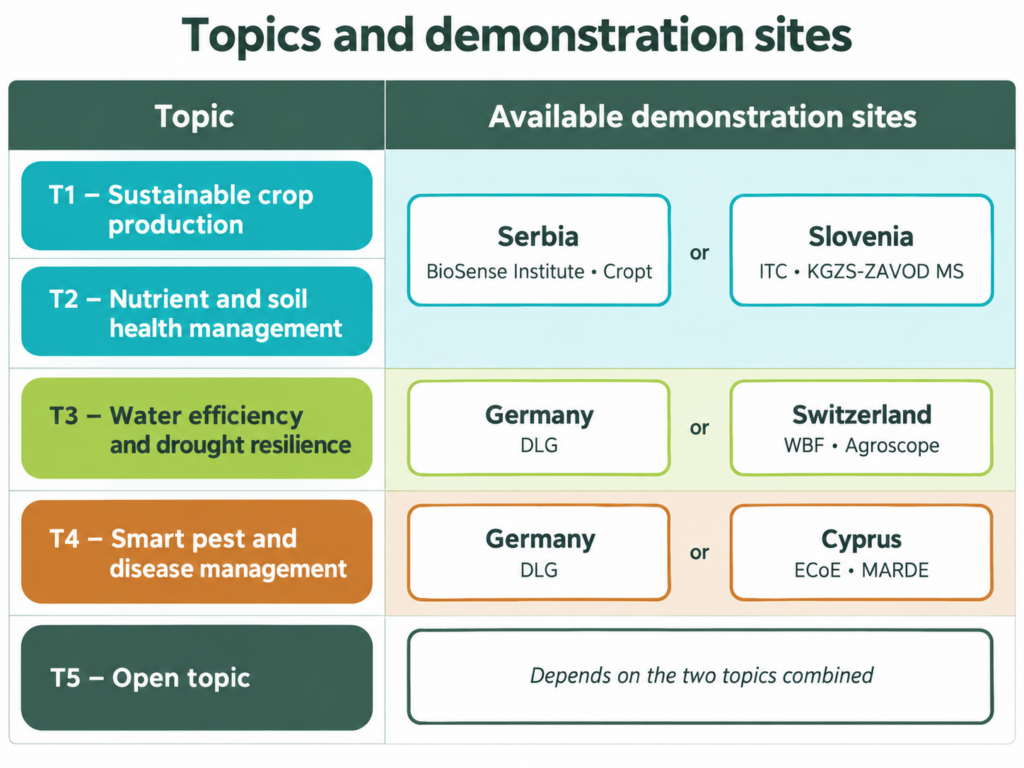
- Demonstration site: pick one primary site from those available for your topic. T1 and T2 offer Serbia or Slovenia, T3 offers Germany or Switzerland, and T4 offers Germany or Cyprus. Physical trials and travel happen only there, and a paired secondary site is covered by a digital replication with no on-site work.
- Impact evidence: show credible evidence for at least one target: over 15% higher yields, over 40% less pesticide use or over 20% less water use.
- Mandatory outputs: a demonstration event for at least 10 participants, one training session for end users, an EIP-AGRI practice abstract, reusable training materials, a demo video, a podcast appearance and at least one social media post per month.
- Budget: eligible costs are personnel, other goods and services, travel, depreciated equipment and a 25% flat indirect rate. Subcontracting is not eligible, and travel to mandatory events must be budgeted.
Evaluation and selection process
Proposals go through four steps:
- Eligibility check by the Open Call Team against the formal criteria.
- Remote expert evaluation by two independent evaluators.
- Online interviews: the top 3 per topic get a 30-minute pitch and Q&A.
- Final selection based on consensus scores.
Each criterion is scored from 0 to 5, without half points from individual evaluators. The minimum threshold is 3 out of 5 per criterion and 12 out of 20 overall. The criteria are:
- Alignment: fit with call and topic goals, and consistency of the TRL progression.
- Excellence: innovation, methodology, technical credibility and responsible, inclusive design.
- Impact: benefits, adoption and exploitation potential, and dissemination.
- Implementation: team capacity, work plan, budget realism and risk management.
The top-ranked proposal in each topic is selected by default, and two proposals go on a reserve list. At the interview stage, consortium representatives also check technical compatibility, demo-site feasibility and IPR conflicts, which can lead to a lower-ranked proposal being selected instead. Any unspent budget goes first to the next-best Topic 5 proposals, and the call may offer partial funding.
Additional support beyond funding
Funding also comes with practical support. Beneficiaries get a topic-specific mentor, mandatory training, access to the platform’s data and development environment, and real pilot sites to test on. Additionally, there’s an on-demand technical helpdesk for architecture, Data Cubes, EO services, the IoT Observatory and market data. Awardees also keep the intellectual property of their solution.
Final thoughts on NOSTRADAMUS Open Call #1
This call stands out because it ties a modest grant to real infrastructure: ready-to-use satellite, IoT and market data, working modules, pilot sites and hands-on mentoring. It suits SMEs, start-ups and small mid-caps that already have a lab-validated agri-tech or geospatial prototype (TRL 4+) and a team comfortable with Python and open-source development. It is also a good fit for companies that can bring in a research partner or farmers’ organisation to validate the solution.
More information
Don’t miss the opportunity that could be the turning point of your success

Follow us on social media so you won’t miss any upcoming Info Days or Cascade Funding Opportunities