

DS4SSCC-DEP – Call for Pilots Round 4: Deploy a Data Space for Smart Communities in Europe
Funding and support for pilot consortia led by local and regional public administrations to develop and validate cross-sectoral data sharing services as part of the European Data Space for Smart Communities, aligned with the EU’s green-digital transformation agenda.
About DS4SSCC-DEP
The European data space for smart communities (DS4SSCC-DEP) is a deployment action funded under the Digital Europe Programme (DEP) that aims to validate and scale an EU-wide cross-sectoral data space for cities and communities. The project builds on the prior DS4SSCC preparatory action, which defined the governance and technical blueprint for data spaces in smart and sustainable urban environments.
The project has three main objectives:
- To establish a large-scale federated and innovative data space, aligned with the EU Smart Middleware Platform (Simpl) and broader data space ecosystems.
- To validate and refine the data space blueprint through approximately 20 cross-sector pilot implementations across different EU communities.
- To foster innovation and ecosystem alignment, engaging stakeholders, ensuring compliance with sector-specific legislation and strengthening ethical considerations in AI-enabled local solutions.
This is the fourth and final round of the DS4SSCC-DEP Call for Pilots (CfP). It seeks to onboard approximately 10 additional pilots, further validating the vision for a European data space for smart communities.
The call is open from 1 April to 31 May 2026 and targets local and regional public administrations in EU Member States and Digital Europe Programme associated countries, along with other partners partners –companies, universities, NGOs and other eligible entities.
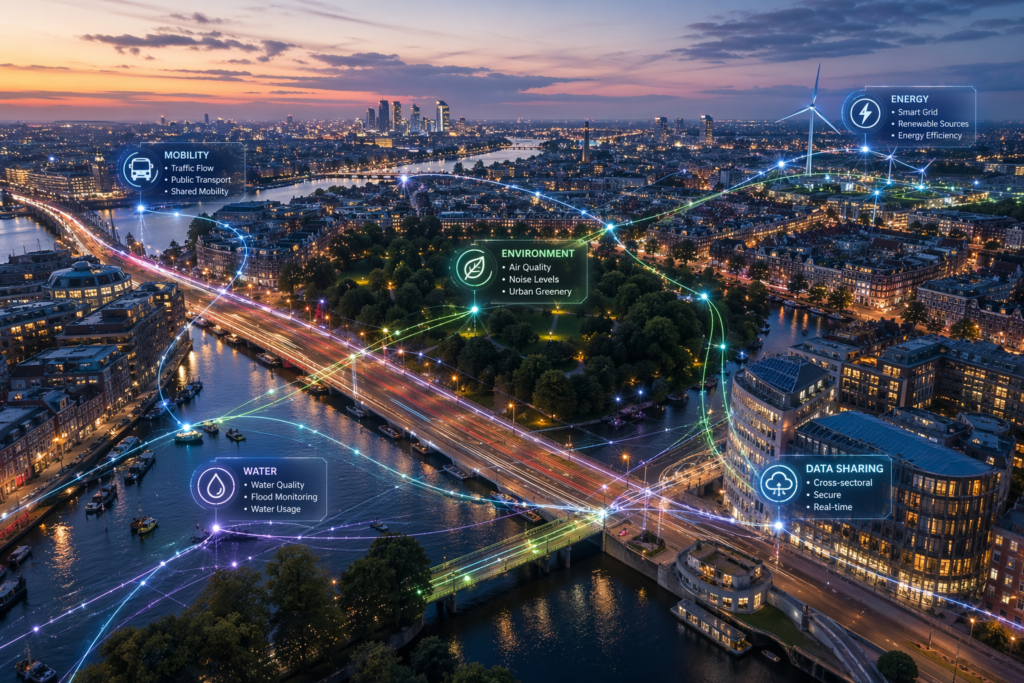
Pilot consortia are required to develop new data services based on cross-sectoral data sharing across at least two of the following thematic areas:
- Predictive traffic management and sustainable mobility planning.
- Data services related to weather, climate and extreme weather events.
- Management of energy flows in a city or community context.
- Zero pollution actions (e.g. air, water, soil or waste).
- Any other domain under the New European Bauhaus initiative, including urban design, building management, public services and nature-based solutions.
The key requirement is that pilots must demonstrate the applicability of the DS4SSCC blueprint and the feasibility of federating with other European data spaces. Data sharing must be cross-sectoral within each participating city, even if cross-border sharing between sites is desirable but not strictly mandatory.
Why Apply to DS4SSCC-DEP Round 4?
Each selected pilot can receive between €250,000 and €500,000. It is important to note that this is a co-funding model: applicants must cover at least 50% of the total pilot costs through their own direct financing. The EU reimbursement rate is therefore capped at 50% of eligible costs, based on the actual costs incurred and submitted in interim and financial reporting.
Payments are made in two instalments: 50% as pre-financing upon entry into force of the Grant Agreement, and the remaining 50% upon approval of the final technical and financial reports.
Pilots receiving more than €325,000 must also include a Certificate on Financial Statements from an external auditor with their final report.
Success Stories from previous open call
Over the previous three rounds, launched between June 2024 and February 2025, 11 pilots across Europe have already been selected and are currently in various stages of implementation.
Examples:
- UrbanMind (Round 1 – Kranj, Slovenia & Pula, Croatia): This pilot expands the Pametna Mlaka (“Smart Swamp”) data space into a fully scalable cross-border platform. By combining sensor-based micro-location environmental monitoring with predictive traffic analytics, UrbanMind targets a reduction of CO₂ emissions of 10–25% and a cut in traffic congestion of up to 30%.
- BeatTheHeat (Round 2 – Cartagena, Spain & Taranto, Napoli and Lambersart, Italy): A cross-border pilot integrating mobility, climate, energy and urban planning data to tackle heat islands and assess the quality and climate resilience of public spaces in coastal Mediterranean cities. The project combines social fragility indicators, green capital monitoring and land-use cartography to support urban planning officers and welfare decision-makers with actionable, data-driven services.
- Geo4Water (Round 3 – San Javier & Valencia, Spain; Oslo, Norway; Donegal, Ireland): A four-city geodata space integrating satellite imagery, environmental sensors, weather data and AI services to monitor and respond to water-related climate emergencies. The pilot delivers rapid damage assessment tools and historical event records that strengthen long-term urban resilience.
Who Can Apply?
Applications must be submitted by a consortium of at least two local or regional public administrations from different eligible countries – EU Member States or DEP associated countries. The Lead Partner is recommended to be an EU local or regional administration. If it is not, additional eligibility checks apply that may delay the start of the pilot.
Other eligible consortium partners include companies, large enterprises, research institutions, universities, NGOs and public entities. There is no stated cap on the number of partners, though the overall maximum grant per entity across all rounds is €1,000,000, and no entity can act as Lead Partner more than once under the DS4SSCC-DEP framework.
All entities must not be controlled by an ineligible country. For most non-public entities, an Ownership Control Declaration (OCD) must be submitted within 14 days of awarding.
Matchmaking support is also available: two sessions are organised during the application period, and interested organisations can join the Stakeholder Forum (over 400 members) or contact support@ds4sscc.eu to request bilateral matchmaking.
How to Apply to DS4SSCC-DEP
Applications must be submitted in English by email to apply@ds4sscc.eu before 31 May 2026 at 23:59 CET. The complete submission package consists of four documents:
1. Application Form (PDF): the main proposal document.
2. Pilot Budget including resource plan (Excel): detailed budget following the DEP cost structure.
3. Letters of Commitment (signed PDFs): from all local public administrations and co-financing partners.
4. Ethics and Data Protection Self-Assessment (Excel): evaluating the pilot’s maturity regarding ethical and data protection challenges.
Important dates
-
Submission period: 1 April 2026 – 31 May 2026 (23:59 CET)
-
Evaluation period: June 2026
-
Notification: 3 July 2026
-
Contract negotiation: 3 – 31 July 2026
-
Onboarding workshop: August 2026
- Implementation period: 1 August 2026 – 31 October (3 months)
Proposal Requirements
The application must be submitted using the predefined templates. Key sections of the Application Form include:
- Description of the current digital platform, digital twin or emerging data space in place at each community (demonstrating a sufficient level of technical maturity).
- Mapping of data spaces building blocks into the platform architecture, using the Catalogue of Specifications.
- Standards and implementations used for each building block (at minimum: data models, data formats and APIs must be interoperable).
- Description of how the pilot will incorporate required components: Authorization Policies Store, Universal Trust Data Registry integration, and Federated Catalogue description of data and service offers (following DCAT specifications).
- A detailed implementation plan, roles of participants, datasets to be used and use case for blueprint validation.
- Indication of which Minimal Interoperability Mechanisms (MIMs) will be implemented. Compliance with at least MIM1 (Interlinking Data), MIM2 (Representing Data) and MIM6 (Securing Data) is mandatory.
On the budget side, eligible costs include personnel, subcontracting (limited and justified), travel and subsistence, equipment (depreciation/leasing) and other goods and services. Indirect costs are calculated at a flat rate of 7%. Infrastructure costs, sub-grants and large research infrastructure are explicitly ineligible.
Evaluation and Selection Process for DS4SSCC-DEP
Applications are evaluated by an Evaluation Committee of at least three experts (both DS4SSCC-DEP partners and external stakeholders), with Ethics Board members reviewing the Ethics and Data Protection Self-Assessments in parallel. The process follows individual scoring, then a consensus group meeting, then final ranking by the Evaluation Team.
Three criteria are assessed on a scale of 0 to 5, each with a minimum passing threshold of 3 points and an overall threshold of 10 out of 15:
- Relevance: alignment with DEP objectives, contribution to long-term EU policy goals and adherence to the DS4SSCC blueprint.
- Implementation: maturity of the existing platform, soundness of the work plan and business case, consortium capacity and co-funding source, and ethical alignment.
- Impact: expected outcomes, societal benefits, environmental sustainability in line with the European Green Deal, and contribution to the European data space for smart communities.
In case of equal scores, priority is given first to higher Relevance scores, then to higher Impact scores.
Additional Support Beyond Funding
Beyond the financial support, selected pilots are enrolled in a structured support programme lasting the full duration of their implementation. This includes an onboarding workshop, three dedicated mentor meetings at key implementation milestones, access to a pool of technical, business and governance experts, and curated training materials. Participation in the Pilot Support programme is mandatory and should be reflected in the pilot budget.
Final Thoughts on DS4SSCC-DEP
The DS4SSCC-DEP 4th Call for Pilots is designed specifically to support the deployment of digital infrastructure and services across EU member states, with a strong public-sector orientation. This means the programme is built around local and regional administrations as primary actors, and the funded activities focus on real-world deployment and validation rather than research and development.
For cities and communities that already operate a data platform, digital twin or an emerging data space, this call represents a concrete pathway to connect their existing infrastructure to a European federated data space, validate it against an established blueprint and access a structured network of technical experts, peer cities and EU-level stakeholders.
With approximately 10 new pilots to be selected and an implementation period starting in August 2026, the fourth round closes a programme that has collectively distributed €15.3 million to advance cross-sectoral data sharing in European communities. For eligible consortia with the technical maturity and the institutional commitment to participate, this is a well-supported, clearly structured opportunity to be part of the foundation of Europe’s smart communities data ecosystem.
More Information
Don’t miss the opportunity that could be the turning point of your success

Follow us on social media so you won’t miss any upcoming Info Days or Cascade Funding Opportunities

FutureProofTextiles 1st Open Call – Digital and Green Innovation for Textile SMEs