


COP-PILOT Open Call #1 – Selection of innovators to integrate and pilot Cloud-Edge-IoT solutions within the existing platform framework
Funding and support for the deployment of pilots within 4 clusters throughout the European Union (mining, smart cities, agriculture/energy and vineyards). The piloting is done with the objective of developing and testing a Collaborative Open Platform (COP) that integrates AI-driven tools, SLA-preserving automation and secure infrastructure to bring cross-sector collaboration, innovation and societal impacts.

About COP-PILOT
COP-PILOT seeks to create a Collaborative Open Platform (COP) PILOTing framework enabling end-to-end orchestration through platform integration, supporting real-world applications across the service domains and sectors of the clusters which form the consortium.
The main objectives of COP-PILOT are:
- Open Multi-Layer Orchestration Platform: where to manage collaborative solutions across very different areas using the IoT-to-edge-to-core computing continuum.
- AI-Based Service Onboarding: to reduce complexity in onboarding large-scale services with automatic SLA compliance through advanced AI-driven extensions (LLM-UI plugin).
- Auto-Pilot Tool: to allow infrastructure owners to securely register domain clusters, automate expansion, and manage access thanks to declarative polices that use standardized TMF data models and APIs.
Some other objectives of the program include designing large-scale pilots, enabling cross-sector trust, analyzing the market potential and sustainability impact of the COP-PILOT platform and enhancing the adoption of the platform.
The project will allocate 4 million euros to fund around 20 projects through two open calls. The first call will have a budget of 1.6 million euros and will provide funding for about 8 projects (2 per cluster). While the second call, expected for the second half of 2026, will fund approximately 12 projects with a budget of 2.4 million euros.
About COP-PILOT’s clusters
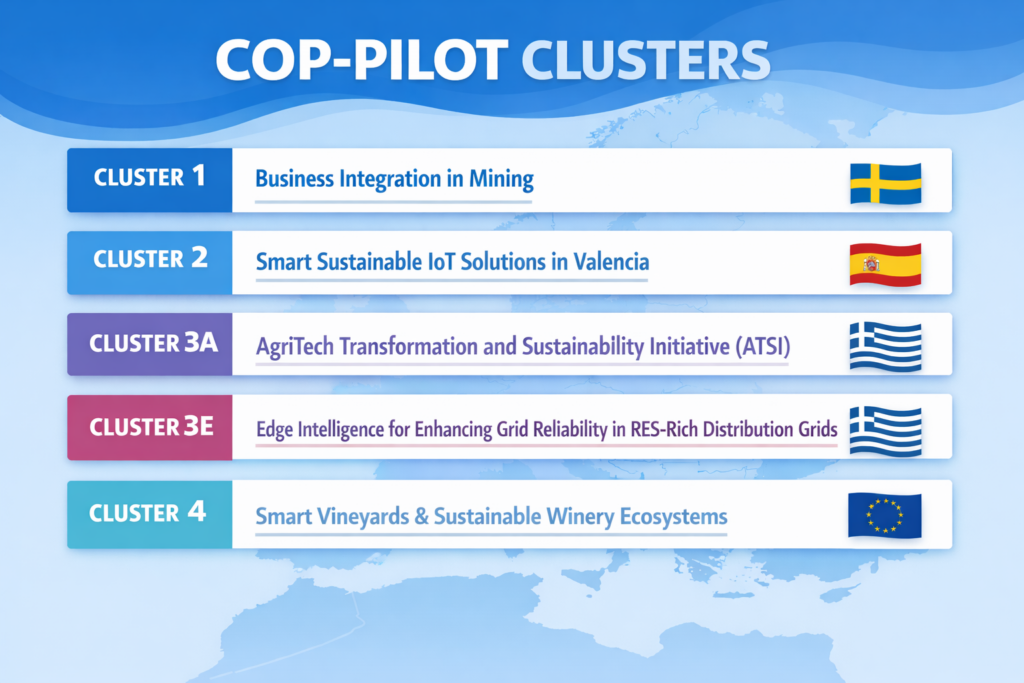
In the COP-PILOT consortium there are 4 partnering clusters from different sectors and countries across the European Union, these are the following:
Cluster 1. Business integration in Mining (Sweden)
The cluster drives digital transformation in mining through a secure, scalable and interoperable computing continuum (IoT, edge and cloud systems). It enables advanced digital services to enhance safety, efficiency and sustainability in underground environments.
Cluster 2. Smart Sustainable IoT Solutions in Valencia (Spain)
Cluster 2 pilots smart sustainable IoT solutions across the city, port, industrial park and university campus that improve mobility, safety, waste management, flood response and port operations. The cluster addresses key technical, regulatory and scalability challenges while enabling real-time data analytics and AI-driven decision-making.
Cluster 3A. Agritech Transformation and Sustainability Initiative (Greece)
It strengthens interoperability and data sharing across the agricultural value chain, integrating IoT, edge computing and robotics to enhance leafy vegetable production. It deploys sensors, drones and agri-robots for real-time crop monitoring, pest control and targeted interventions. The pilot also advances Just-In-Time logistics and smart supply chains through tracking, routing optimization and blockchain.
Cluster 3E. Edge Intelligence for Enhancing Grid Reliability in RES-Rich Distribution Grids (Greece)
This Cluster addresses the integration and intelligent management of Distributed Energy Resources and flexible loads within active distribution grids. It demonstrates how IoT, cloud–edge architectures and AI-driven analytics support decentralized, two-way energy systems while mitigating congestion, overvoltage and supply variability. The pilot focuses on biogas production and EV charging.
Cluster 4. Smart Vineyards & Sustainable Winery Ecosystems (European Union)
The fourth Cluster supports sustainable viticulture by integrating interoperable IoT, AI/ML and robotics across vineyards and wineries. It connects smart irrigation, production monitoring and circular IoT lifecycle management. By combining multi-source field data with distributed orchestration, the cluster enhances water efficiency, production planning and operational resilience.
About COP-PILOT’s Open Call #1
As said, the first open call allocates 1.6 million euros for 8 projects (200k euros per project) which showcase that COP-PILOT’s innovative and emerging solutions can be adapted, tested and validated in different infrastructures, sectors and settings.
The Open Call #1 allows two workflows: 1- Service Providers and 2- Infrastructure Owners. For the first workflow, applicants provide software solutions (AI, analytics or automation) to be onboarded on COP-PILOT’s LLM portal to deploy it on COP-PILOT’s testbeds.
For the second workflow, awardees are infrastructure owners (hardware, testbeds, labs or compute clusters) who connect their private domain using the “auto-pilot” feature to COP-PILOT’s ecosystem.
Each cluster has proposed some use cases to deploy these solutions and challenges that applicants should address as follows:
Cluster 1 – Mining
USE CASES
- Iot Mining Seismics.
- Logistics of IoT.
- Condition Monitoring & Predictive Maintenance.
- IoT-Edge-Cloud Continuum for Digital Mines.
CHALLENGES
- Achieving reliable, low-latency data exchange.
- Enabling interoperability.
- Scaling and automating data processing.
- Overcoming operational barriers to deploying smart IoT solutions.
Cluster 2 – Smart City
USE CASES
- 5G-connected radars for traffic classification and vehicle counting.
- Flood warning and mitigation system through radar sensing.
- Smart resources management in the UPV Campus.
- Maritime traffic monitoring and berthing assistance.
- IoT-driven smart building management.
- IoT-based environmental quality monitoring system.
CHALLENGES
(Solutions are expected to start at a minimum TRL 6 and reach TRL 7-8 by the end of the project)
- Smart Access and Resource Management at UPV Campus.
- Robotic patrol and surveillance at UPV Campus (and/or Valencia City).
- Autonomous terminal shuttle.
- Municipal buildings management.
Cluster 3A – Agriculture
USE CASES
- Integrated Precision Agriculture and Crop Monitoring.
- Advanced AgriRobotics for Autonomous Intervention.
- Secure Data Management and Interoperability.
- Smart Logistics and Supply Chain Optimization.
CHALLENGES
(Solutions are expected to start at a minimum TRL 6 and reach TRL 7-8 by the end of the project)
- Interoperable Plant Sensor Prototypes.
- Edge-Controlled Smart Irrigation and Microclimate Systems.
- Smart Freshness and Quality Sensors for Packaged Produce.
- Onboard Tractor and Machinery Activity Logging for FMIS & ISOBUS Integration.
- AR/XR Field Decision Support Dashboards.
- Robotic Solutions for Automated Cultivation Practices.
Cluster 3E – Energy
USE CASES
- Harvesting in real-time flexibility from active electricity distribution grids.
- Ensuring uninterruptible power supply for fast EV chargers to accommodate high mobility demand.
- Predictive maintenance and monitoring of anaerobic digestion in a biogas plant to ensure reliability in electricity grids.
CHALLENGES
- Edge Intelligence for predictive Maintenance in RES.
- Flexibility modelling and harvesting techniques from residential feeders.
- Industrial users (e.g., factories) offering surrogate or analytical models mapping flexibility potential to be exposed to DSOs.
- Edge AI analytics tor EV Charging stations or Biomass plants or DSOs.
Cluster 4 – Vineyards
USE CASES
- Circular IoT Sensor Lifecycle Management.
- Water Utilisation Efficiency Through Satellite and IoT Data Fusion.
- Smart Winery Production Optimisation Through OEE Monitoring.
- Advanced Agricultural IoT for vineyards by using 5G Green powered site and AGV Remote Driving.
CHALLENGES
(Solutions are expected to start at a minimum TRL 5-6 and reach TRL 7-8 by the end of the project)
- Advanced Vineyard Monitoring, Zoning & Environmental Intelligence.
- Water Efficiency, Winery Production Intelligence & Energy Performance.
- Vineyard Robotics, Automation & Field Operations Support.
- Circular IoT Sensor Lifecycle Management.
- Cross-Domain Data Interoperability & GAIA-X/IDSA-Aligned Services.
- Operator Dashboards, Decision-Support & Human-Machine Interfaces.
Why Apply to this Call?
This call offers funding for eight projects (maximum 2 per cluster), with a total sum of €200,000 per project. The funding rate is 100% of eligible costs (lump sum) disbursed in two installments:
1. 50% upon contract signature, expected in June/July 2026 (maximum of €100,000).
2. the other 50% after the final report is approved, expected by 2027 (limit of €100,000).
Also, if awarded, the beneficiaries will be enrolled in a structured eight-month support program consisting of technical assistance and opportunities for real-world validation and networking within Europe’s innovation ecosystem.
Who Can Apply?
Applications can be submitted either by single SMEs or consortia lead by an SME.
To be eligible, the organization/organizations applying must be:
- registered in an EU Member State or Horizon Europe Associated Country,
- not bankrupt or subject to insolvency proceedings,
- not guilty of grave professional misconduct or fraud,
- and compliant with tax and social security obligations.
In case of applying as a consortium, there is a recommended limit of maximum 5 partners. Additionally, they can be from the same country. Eligible partners, other than the leading SME, are:
- SMEs.
- Large enterprises.
- Research institutions and Universities.
- Non-profit organizations.
- Public entities (where permitted).
How to Apply?
The proposal should be completed using the mandatory Proposal Guideline Word Document and every section must follow the rules stated in terms of format, length and content.
The proposal and its related documents (signed Declaration of Honour, SME Checklist and Consortium Agreement –if applicable) must be completed in English, be saved as PDF files.
Once all documentation is ready, the applicant or its authorized representative must register on the submission portal. Finally, through the “Get Funded” and “Apply Here” buttons, the proposal is submitted by filling the online form and uploading the PDF documents.
It is important to note that each proposal must target only one cluster. However, multiple proposals (one per cluster) can be submitted.
Important Dates
- Launch time: 16 February 2026 at 09:00 CET
- Informative Webinar: 26 March 2026 at 15:00 CET
- Submission Deadline: 4 May 2026 by 22:00 CET (extended from the original 17 April).
Proposal Requirements for COP-PILOT
As stated in the Proposal Guidelines: it must be completed in English, have a maximum length of 12 page and use standard formatting.
The mandatory sections to complete are the following:
- Project overview/summary (maximum 300 words).
- Section 1. Excellence.
o 1.1. Detailed Description.
o 1.2. Infrastructure Requirements.
- Section 2. Impact.
o 2.1. Expected Impact and Sustainability.
o 2.2. Expected Outcomes.
- Section 3. Quality and Efficiency of the Implementation.
o 3.1. Workplan and Timeline.
o 3.2. Team Qualifications.
o 3.3. Budget and Justification (following the lump sum model).
- Annex I: Declaration of Honour (mandatory –to be signed).
- Annex II: SME Checklist.
- Annex III: Privacy & Ethics.
- Annex IV: Consortium Agreement (if applicable).
Evaluation and Selection Process for COP-PILOT
Proposals will be evaluated on a 0 (fail) to 5 (excellent) scale on the following three criteria –minimum threshold of 3 points (good) per criterion. Each criterion has subitems based on the sections of the Proposal Template.
1. EXCELLENCE
1.1. Clarity and Pertinence of Objectives.
1.2. Soundness of Methodology.
1.3. Ambition and Innovation.
2. IMPACT
2.1. Strategic Fit and Expected Impact.
2.2. Sustainability and Replicability.
3. IMPLEMENTATION (Quality & Efficiency)
3.1. Work Plan Quality and Feasibility.
3.2. Consortium Capacity and Expertise.
3.3. Management and Resources.
Upon scoring, a weighting factor is applied to the raw scores to calculate the final proposal ranking. The minimum overall threshold is 60 points.
| CRITERION | WEIGHTING FACTOR | MAXIMUM SCORE | THRESHOLD |
|---|---|---|---|
|
1. EXCELLENCE
|
x 8 |
40 |
24 |
|
2. IMPACT |
x 6 |
30 |
18 |
|
3. IMPLEMENTATION |
x 6 |
30 |
18 |
|
TOTAL |
|
100 |
60 |
To ensure operational feasibility the Excellence criterion has the highest weighting factor.
Regarding the selection process timeline, it is composed of 5 evaluation steps as follows:
- Step 1. Eligibility Check (5-8 May 2026).
- Step 2 (if eligible). Feasibility Screening (8-15 May 2026).
- Step 3 (if feasible). Independent Expert Scoring (18 May-15 June 2026).
- Step 4. Consensus Meeting (22 June 2026).
- Step 5. Notification (1 July 2026).
- Contract and project start. Tentatively by 15 July 2026.
Additional Support Beyond Funding
Selected projects will receive:
- Technical mentoring and training.
- Integration support with the COP-PILOT platform.
- Access to pilot infrastructures.
- Visibility within the European innovation ecosystem.
Final Thoughts
COP-PILOT aims to develop and validate a Collaborative Open Platform enabling secure, AI-driven orchestration across IoT–edge–cloud environments, supporting high-TRL, cross-sector deployments. Through Open Call #1, the project allocates €1.6 million to fund eight innovation projects that integrate and pilot solutions within one of the four clusters. It offers funding, structured technical support and access to real-life testing environments for service providers and infrastructure owners.
By focusing on interoperability, scalability and secure data exchange, the call encourages solutions capable of operating within complex, multi-domain infrastructures. Overall, the initiative represents a strong opportunity to validate market-ready technologies and accelerate their adoption across European sectors.
More Information
Don’t miss the opportunity that could be the turning point of your success

Follow us on social media so you won’t miss any upcoming Info Days or Cascade Funding Opportunities

FutureProofTextiles 1st Open Call – Digital and Green Innovation for Textile SMEs