Up to €60,000 for SMEs building resilient clean-energy supply chains
RENEW-BOOSTER’s second call puts €800,000 in grants behind SMEs with market-close innovations in floating offshore wind, solar PV and energy networks, through a challenge-driven Strand A and a bottom-up Strand B. Individual SMEs can secure up to €60,000 in total, with Strand B also open to consortia of up to three SMEs. Applications close on 30 November 2026.
About RENEW-BOOSTER
RENEW-BOOSTER aims to drive innovation and industrialisation in three sectors central to Europe’s green transition and energy security: photovoltaics, offshore wind energy and the associated energy networks.
At the project’s core is the Accelerator, which offers tailored support to help SMEs spot opportunities and develop solutions. The work is organised in four work packages: management, communication, innovation and supply chain, and green and digital transition. A quadruple helix approach linking industry, research, government and civil society underpins collaboration, R&D and the formation of industrial consortia.
About RENEW-BOOSTER Open Call #2
The call responds to Europe’s exposure to critical-material dependencies and supply chain bottlenecks in clean-energy technologies. It backs SMEs whose innovations reduce those dependencies, speed up the green and digital transition and support two EU frameworks: the Critical Raw Materials Act (CRMA) and the Net-Zero Industry Act (NZIA). Projects start at TRL 6–7 and must deliver tangible results within a short implementation period.
Proposals can address four areas:
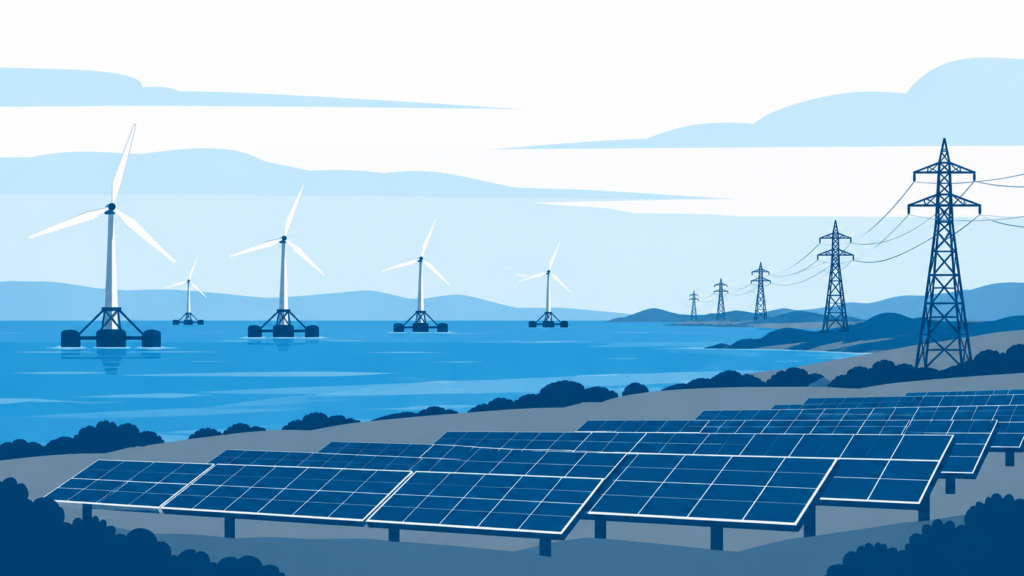
- Offshore wind, particularly floating: turbines, blades, generators, floating platforms, cables, substations and offshore grid technologies with less critical-raw-material use, plus integrated solutions for deployment, operation and maintenance in deep water.
- Photovoltaics: high-efficiency cells, modules and materials (for example replacing aluminium with composites, cutting tin and lead in interconnections, or substituting glass), PV plant architectures, hybrid electricity/heat technologies, recyclability and power electronics.
- Energy networks: SF6-free equipment, cables made from recycled materials, cable health monitoring and forecasting, and smart grid tools such as dynamic line rating and predictive maintenance.
- Cross-sectoral innovation: AI, quantum computing, blockchain and digital twins that optimise energy and environmental performance, plus energy management systems, predictive analytics and environmental-impact tools.
The call is delivered through two strands:
- Strand A – Challenge-driven projects: SMEs answer one of four challenges set by industry leaders: (1) robotic solutions for offshore foundation painting campaigns during the operation phase; (2) scaling cost-competitive production of suction anchors for floating offshore wind; (3) second-life use of industrial batteries; and (4) trusted positioning for offshore wind when GPS fails.
- Strand B – Open calls: SMEs bring their own innovation in PV, offshore wind or energy grids, with no predefined challenge. Between 12 and 72 projects will be selected.
Why apply to RENEW-BOOSTER Open Call #2
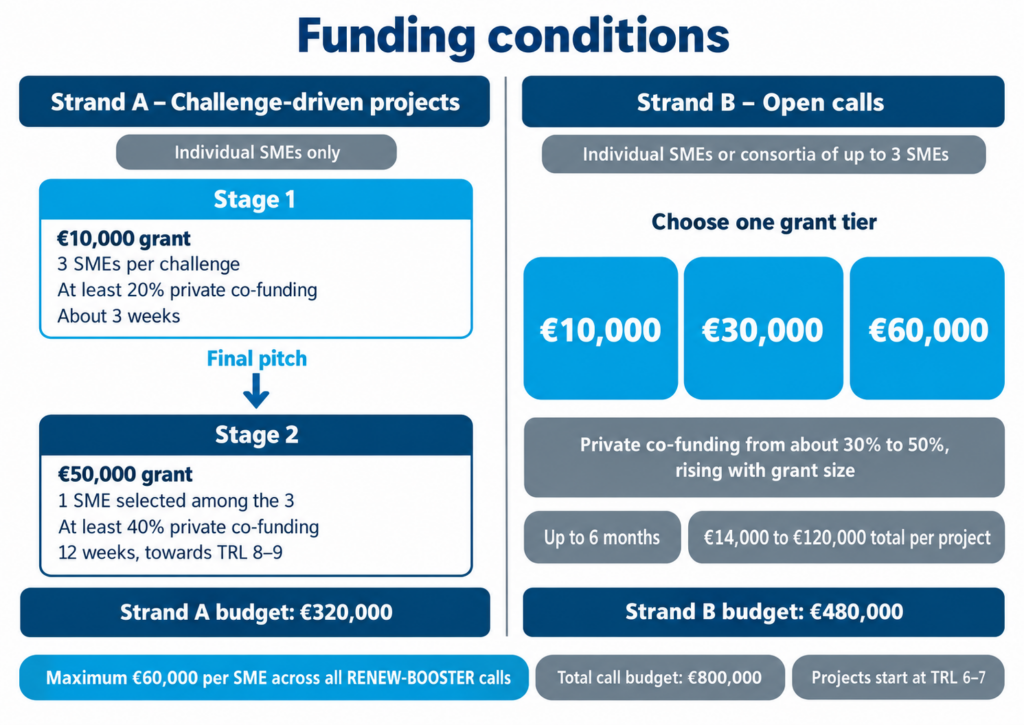
The call has a total grant budget of €800,000, split between €320,000 for Strand A and €480,000 for Strand B, and each SME can receive up to €60,000 in cumulative cascade funding across all RENEW-BOOSTER calls. Each strand gets there differently.
Strand A is staged:
- Stage 1: three SMEs per challenge each receive €10,000 (at least 20% private co-funding) to deliver a product demonstration at TRL 6–7 in about 3 weeks.
- Stage 2: after a final pitch, one of the three is selected for €50,000 (at least 40% private co-funding) to scale up over 12 weeks towards TRL 8–9.
Strand B is a single stage, applicants choose a grant tier of €10,000, €30,000 or €60,000, with a development phase of up to 6 months. Private co-funding rises from about 30% to 50% as the grant grows, so the grant covers roughly 50% to 70% of project costs. The total mobilised budget per project runs from around €14,000 to €120,000
Who can apply?
Only SMEs can apply, and they must meet every criterion below.
- SME status following the EU SME definition.
- Country: established in an EU-27 Member State or another country participating in the Single Market Programme
- Scope: activities must sit within the PV, offshore wind or energy grids value chains
- Policy alignment: proposals must explicitly show their contribution to the CRMA and/or the NZIA.
Strand A is for individual SMEs only; consortia are not eligible.
Strand B accepts individual SMEs or consortia of up to three SMEs. The grant can be paid to a lead SME, which distributes it, but the co-funding requirement applies to each SME individually.
At least 10% of supported SMEs will come from regions outside the partners’ own countries, with particular attention to EU-13 countries.
How to apply to RENEW-BOOSTER Open Call #2
Applications go through the online application form on the EU Survey platform. The form includes:
- Project details and company information.
- Signed declarations, where applicable.
- Budget and work plan, using two separate budget tables: the grant budget and the co-funding budget, which must be properly completed.
- Additional annexes or templates, where applicable.
- A Financial Identification Form.
Important dates
- Call publication: 28 September 2026.
- Application deadline: 30 November 2026 at 17:00 CET.
- Evaluation: December 2026.
- Results communicated: mid-January 2027.
- Contract signature: end of January 2027.
- Project duration: 3 to 6 months from sub-grant signature (Strand A: about 3 weeks for Stage 1 and 12 weeks for Stage 2).
Proposal requirements
Proposals must be clearly tied to the call’s objectives and show relevance to EU priorities on competitiveness, resilience, the green transition and digitalisation. The CRMA and NZIA are described as foundational, so each project must prove its contribution to them through concrete information and figures:
- CRMA: extraction, processing and recycling within the EU will be carefully considered, and improving supply chains for materials such as silica, neodymium or copper is cited as very relevant.
- NZIA: the EU aims for at least 40% of net-zero technology manufacturing to happen within its territory, so relocating part of the manufacturing process or technology components to the EU will weigh strongly.
Co-funding must be the SME’s own financial contribution, evidenced at application and again at reporting. Staff costs, salaries, staff time and any in-kind contributions do not count. Depreciation, recoverable VAT, costs unrelated to the project and costs financed from other public sources are ineligible under both budgets.
Evaluation and selection process
Evaluation runs in sequence: eligibility check, quality evaluation by two independent experts, panel for Strand A (challenge owner and two external evaluators) and a final ranking by total score, subject to thresholds and the available budget.
Each of the three criteria is scored from 0 to 10, with a minimum of 6/10 required on every criterion. The maximum total is 30 points. The call text sets thresholds per criterion only.
- Excellence (10 points): innovation level and novelty, soundness and feasibility of the technical approach within the timeframe, relevance to the call and chosen strand, and clarity and credibility of the solution and outputs.
- Impact (10 points): contribution to supply chain resilience or diversification, contribution to the green and digital transition, market relevance and a credible commercialisation or deployment plan, and measurable outcomes backed by clear KPIs.
- Quality and efficiency of the implementation (10 points): realism of the workplan and timeline, team capacity and expertise, budget adequacy and cost-effectiveness, and quality of risk identification and mitigation.
All evaluators and challenge owners are bound by confidentiality and conflict-of-interest rules. Complaints must be filed within 14 days of the results and can only concern procedural errors or manifest errors in the assessment.
Additional support beyond funding
RENEW-BOOSTER offers more than grants, aimed at strengthening SMEs’ innovation capacity and their chances in future EU programmes:
- Training and competence development: workshops, sessions and practical guidance on sustainability, digitalisation and innovation.
- Business support: mentoring, business process innovation support, and help identifying market opportunities and routes to deployment.
- Networking and collaboration: access to European clusters, customers, R&D organisations and innovation ecosystems, plus matchmaking, international cooperation and opportunities to form partnerships and consortia.
- Enterprise Europe Network: local advisors can support innovation, internationalisation and access to EU funding, although they may not know this programme’s specific rules.
Final thoughts on RENEW-BOOSTER Open Call #2
This call suits SMEs that already have a working solution at TRL 6–7 and want to turn it into a market-ready product with a clear supply chain story. If your solution fits one of the four industrial challenges, Strand A offers a fast route to a demonstration in front of a corporate challenge owner, with up to €60,000 for the winner. If you have your own innovation in PV, floating offshore wind or grids, Strand B gives you more freedom and up to six months to develop it, alone or with two other SMEs. In both cases, plan for real private cash co-funding, and build your case around the CRMA and NZIA, since those frameworks carry the most weight in evaluation.
More information
Don’t miss the opportunity that could be the turning point of your success

Follow us on social media so you won’t miss any upcoming Info Days or Cascade Funding Opportunities
RENEW-BOOSTER Open Call #2 – Offshore Wind, Photovoltaics and Energy Grids